
Nmms,Ntse,Trust -Mat study materials Topic: Situation related problems (Seating arrangement), Mental Ability Study materials online test
Seating Arrangement
'Seating Arrangement' is a sequential arrangement of objects/persons on the basis of predefined conditions.Few Important things to Remember
In this section, we deal with the questions based on setting arrangement of persons or objects. In this type of questions, some conditions are given, on the basis of which candidates are required to arrange objects/person, either in a row or in a circular order or in any other geometrical shape. While making arrangements, it should be noted that all the conditions given are complied with.
Types of seating arrangements:
Circular Seating Arrangement
Row or Column Seating Arrangement
Square Seating Arrangement
In order to solve seating arrangement questions, first of all diagram should be made. By doing so questions are easily and quickly solved.
Types of Questions
There are three types of questions, which are generally asked in various competitive examinations.
Type #1: Arrangement in Linear Pattern
Here, we deal with questions, where a proper arrangement is required to be done in a linear format along a straight line.
Before solving this type of questions, it is necessary to know the given facts.
• When it is not given in the question that in which direction the person(s) is facing, then we assume it facing the North direction. When A, B, C and D are facing in South direction and P, Q, R and S are facing in North direction in a line, the positions to their right and left will be
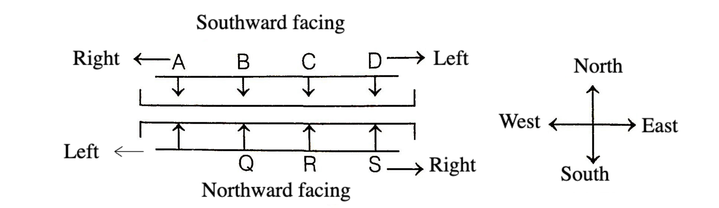
• When A, B are in one line and P, Q in other, then diagonally opposite directions will be When A, B are in one line and P, Q in other, then diagonally opposite directions will be

A is diagonally opposite to Q and B is diagonally opposite to P.
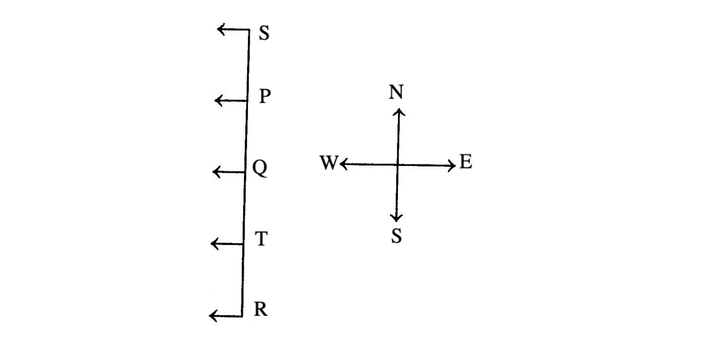
Clearly, from the above diagram, Q is setting in the middle.
Type #2: Circular Arrangement
In circular arrangement, persons/objects are arranged around a circle facing towards or outside the centre on the basis of information provided.
Facing Towards the Centre
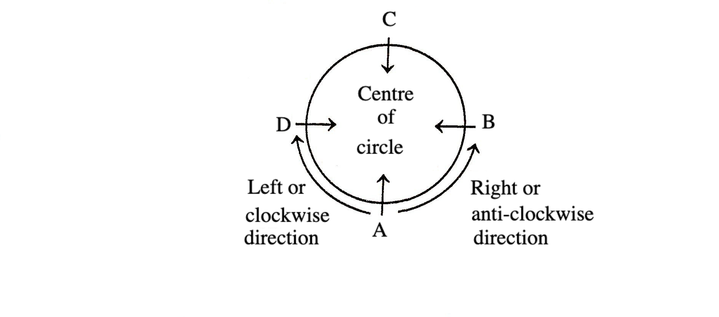
Suppose A, B, C and D are four persons facing towards the centre, then their right and left sides are shown by the arrows in the given diagram. B is on the right side of A and D is on the left side of A.
Memory Add-ons
Facing Centre
• Towards Left – Clockwise Rotation.
Towards Right – Anticlockwise Rotation.
Facing Outside the Centre
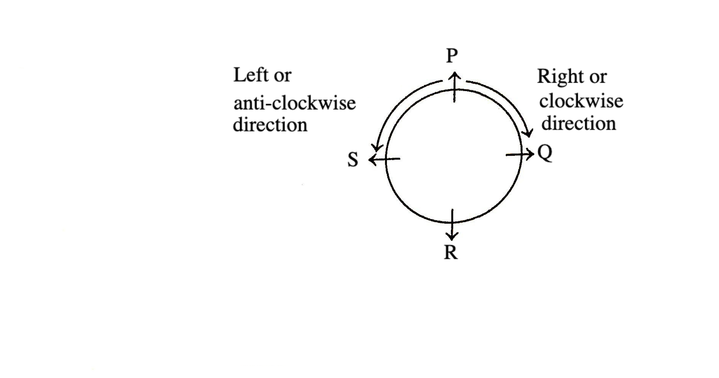
Suppose there are four persons P, Q, R and S. All the persons are facing outside the centre, then their left and right sides are shown in the diagram by arrows. Q is on the right of P and S is on the left of P.
 '
'Memory Add-ons
Facing Outwards
• Towards Left – Anticlockwise Rotation.
• Towards Right – Clockwise Rotation.Type #3: Arrangement in Other Geometrical Shapes
In this type, questions are asked to arrange the person in square, rectangle, pentagon, hexagon or any other geometrical shape.
1. Square/Rectangular Arrangement
In this type of arrangement, objects/persons are placed around a rectangular or a square shaped table facing either at the centre or the direction opposite to centre.The left and right of each person in both the cases can be understood with the help of following diagrams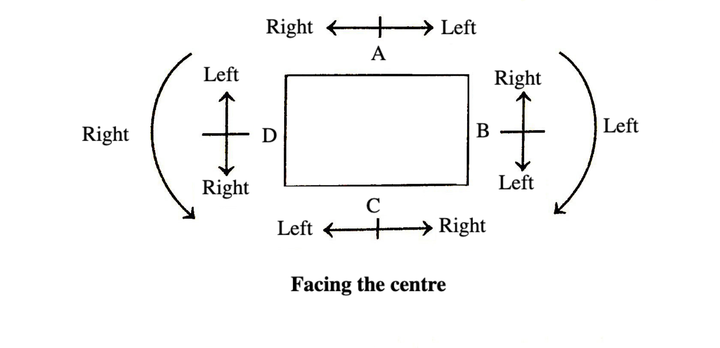
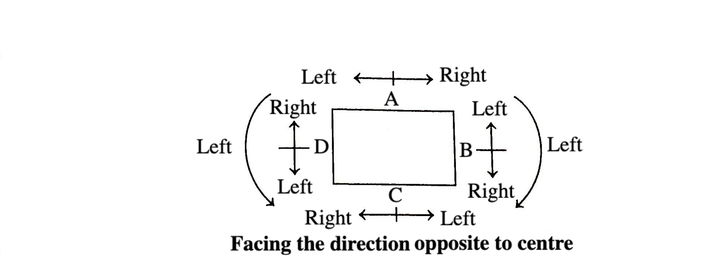
Facing Outwards
• Towards Left – Anticlockwise Rotation.
• Towards Right – Clockwise Rotation.Type #3: Arrangement in Other Geometrical Shapes
In this type, questions are asked to arrange the person in square, rectangle, pentagon, hexagon or any other geometrical shape.
1. Square/Rectangular Arrangement
In this type of arrangement, objects/persons are placed around a rectangular or a square shaped table facing either at the centre or the direction opposite to centre.The left and right of each person in both the cases can be understood with the help of following diagrams
Pentagonal Arrangement
In this arrangement, persons/objects are placed around a pentagonal plane facing either at the centre or the direction opposite to the centre. The left and right of each persons in both the cases can be understood with the help of the following diagrams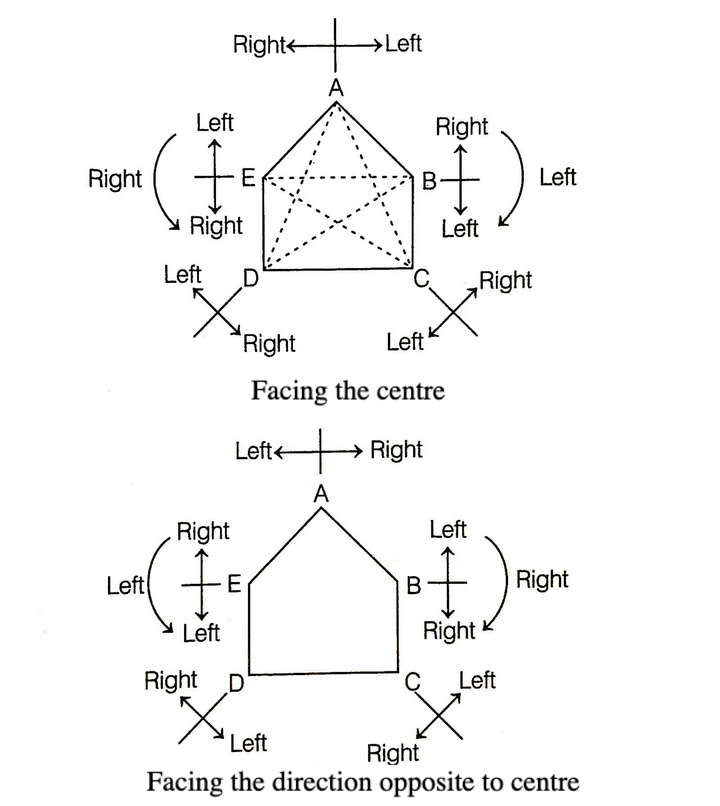
In this arrangement, persons/objects are placed around a pentagonal plane facing either at the centre or the direction opposite to the centre. The left and right of each persons in both the cases can be understood with the help of the following diagrams
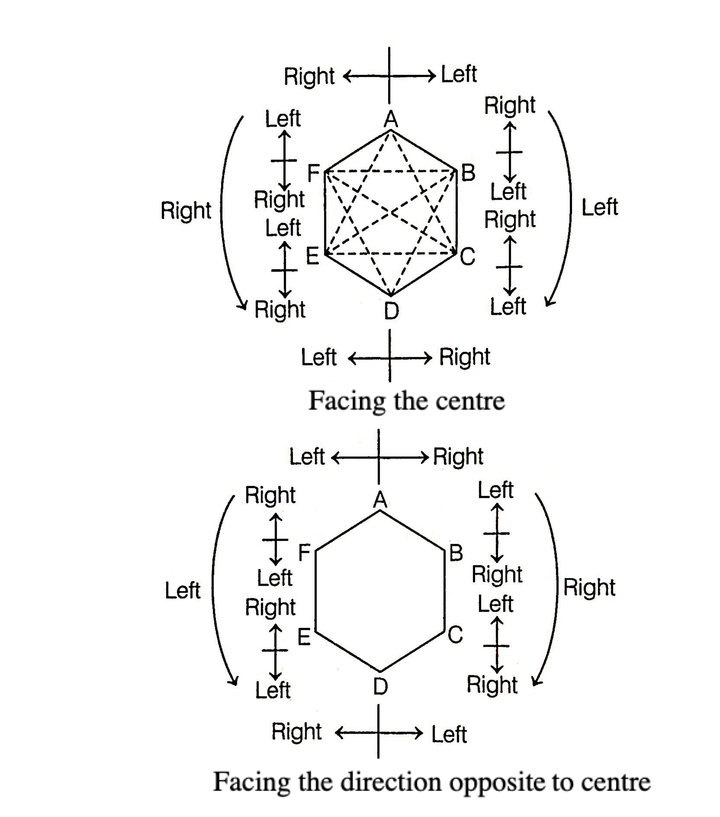
Hexagonal Arrangement
In this arrangement, objects/persons are placed around a hexagonal plane facing either at the centre or the direction opposite to centre. The left and right of each person/object in both the cases can be understood with the help of following diagrams
In this arrangement, objects/persons are placed around a hexagonal plane facing either at the centre or the direction opposite to centre. The left and right of each person/object in both the cases can be understood with the help of following diagrams
Nmms study happy to share this interactive worksheet for your kind practice . This interactive worksheet is prepared by Mr. Prabath Zeal study thank him and appreciate his dedicated work,
Nmms,Ntse,Trust -Mat study materials
Topic:Situation related problems (sitting arrangement)
Mental Ability Study materials
Mental Ability online test
Nmms-Mat-SITUATION RELATED PROBLEMS (SITTING ARRANGEMENT), an interactive worksheet by Zeal Nmms study
liveworksheets.com
liveworksheets.com


Comments
Post a Comment