
Coding-Decoding
Coding means to hide the meaning of any message and decoding means to understand the actual meaning of that message. In questions based on coding-decoding, a word or sentence is coded in a particular way and the candidates are asked to code other word or sentence in the same way or to decode the word or sentence.
To solve these questions, the candidates are required to understand the rule that has been followed to code a particular word/message.
Position of Letters in English Alphabet
Sometimes a word or a sentence is coded by changing the position of English alphabet letters according to a definite pattern, so it is necessary to remember the positions of all the letters in English alphabetical order, both in forward and backward order.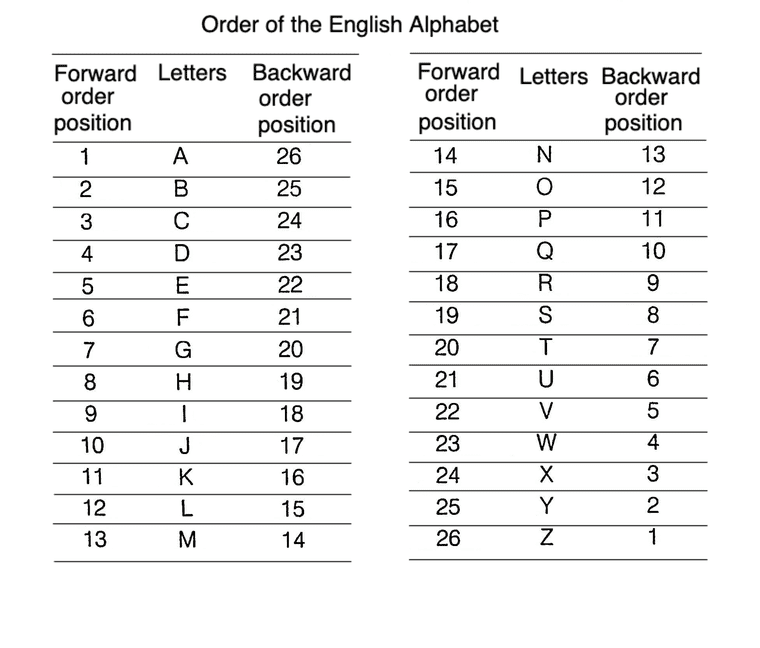
Circular Arrangement of Letters in English Alphabet
1: Clockwise Arrangement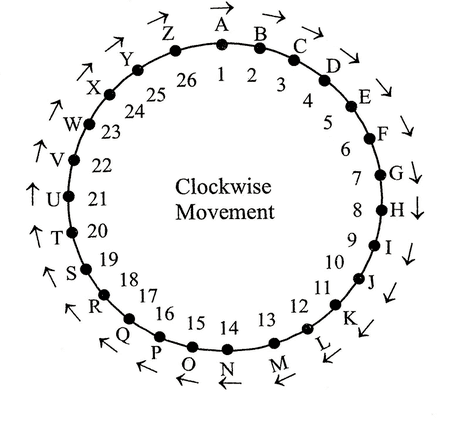 2: Anti-clockwise Arrangement
2: Anti-clockwise Arrangement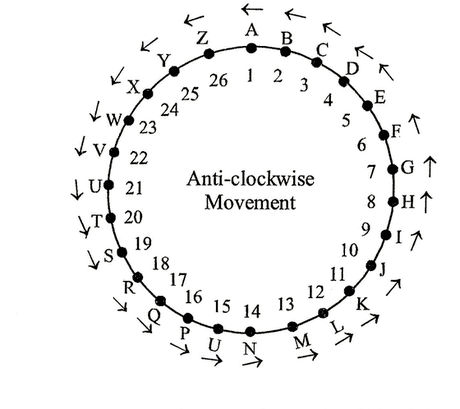 If we have to find the letter one placed forward to A, then the letter will be B and this result can be found out by using either linear or circular arrangement but when one is asked to find the letter which is one letter backward of A (Z is one letter backward A) or one letter forward of Z (A is the one letter forward Z), then only circular arrangement gives such results.
Method to Remember the Position of Letters in English Alphabet
Some method/techniques are given to remember the positions of English alphabets in forward or backward order.
1. By using EJOTY and CFILORUX formulae, we can easily remember the position of letters of English alphabet in forward order.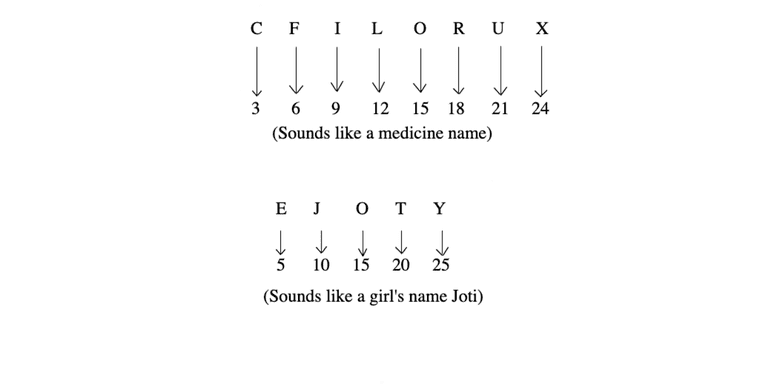 Note:
Note:
Note:Backward order position of a letter
= 27 - Forward order position of letter
e.g. Backward order position of B
= 27 - Forward order position of B
= 27 - 2 = 25
2. By Using V Q L G B and X U R O L I F C, we can easily remember the position of letters of English alphabet is reverse order.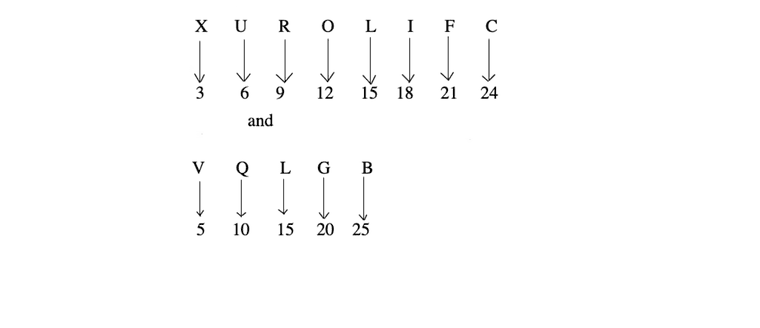
Types of Coding - Decoding
Following are the categories/Types of coding-decoding, which are generally asked in various competitive examinations.
Type #1: Letter/Number Coding
In this type of coding, we deal with questions, in which the letters of a word are replaced by certain other letters or numbers according to a specific pattern/rule to form a code. You are required to detect the coding pattern/rule and answer the question(s) that are asked, based on that coding pattern/rule.Type #2: Direct Coding
In direct coding, the code letters/numbers/ symbols occur in the same sequence as the corresponding letters occur in the words. This is basically a direct substitution method.Type #3: Conditional Coding
In this type, letters/numbers are given along with their code. Candidates are required to find the codes for a particular letter group/word/number according to certain conditions given in the questions.
Directions (Examples 11 - 13) Study the following letters and their corresponding digits code followed by certain conditions of coding and then answer the questions given below them by finding out which of the digits combinations given in (a), (b), (c) and (d) is the coded form of the letters-groups given in each question and mark your answer accordingly.
Letters P N A J I R E B U K
Digits/Codes 5 3 9 1 4 6 2 7 0 8
Conditions
(I) If both the first and the last letters in the group are vowels, both should be coded as $.
(II) If both the first and the last letters in the group are consonants, both should be coded as #.Type #4: Fictitious Language Coding
Here, coded form of two or more sentences is given and you are required to find the code of a particular word or message.
To analyse such codes, any two messages bearing a common word/number are picked up. The common code will represent that particular word/number.
Proceeding similarly by picking up all possible combinations of two, the entire message can be decoded and the codes for every individual word/number can be found.
Type #5: Substitution Coding
In this type of coding, some particular words are coded with certain substituted word and on the basis of substituted word, the code of given word is derived.
Example 18: If 'white' is called 'blue', 'blue' is called 'red', 'red' is called 'yellow', 'yellow, is called 'green', 'green' is called 'black', 'black' is called 'violet' and 'violet' is called 'orange', then what would be the colour of human blood?
(a) Red
(b) Green
(c) Yellow
(d) Violet
(e) Orange
Solution: (c) We know that, the colour of human blood is 'red' but here 'red' is called 'yellow'. So, the colour of human blood will be 'yellow'.
Nmms study happy to share this interactive worksheet for your kind practice . This interactive worksheet is prepared by Mr. Prabath Zeal study thank him and appreciate his dedicated work,Nmms,Ntse,Trust -Mat study materials
Topic:Decoding,
Mental Ability Study materials online test
Nmms-mat-DECODING, an interactive worksheet by Zeal nmms study
liveworksheets.com
liveworksheets.com


Comments
Post a Comment